This week:
- Gratitude to the moving crew!
- Personnel commitments – please complete the form!
- Finding Hackley and Diller Hall for Monday’s rehearsal
Gratitude to the moving crew!
The move is complete! We have officially moved to The Hackley School! Many thanks to the crew who volunteered yesterday, and especially to Eric, who organized everything and led the brigade. A big thank you to everyone who lifted and lugged and stacked and drove around the county to make this happen! Pictured above (left to right): Gina, Nate, Jake, David, me, Stan, Dave, Chris, Marianne, Eric, Ava (Mike’s daughter), and Mike.
We are grateful to Björn Olsson & Karina Ringeissen for 21 years of rehearsals and performances at TMH, and to Patricia Compton at UUFNW for their kindnesses and assistance during this transition year.
It’s truly time for “A New Dawn” in 2026-2027!
Personnel commitment form
So far we have only 17 responses to the form for next season. Please fill out this form by next Monday, June 29 so we can plan for our inaugural season at Hackley!
First rehearsal at Hackley
Check out the rehearsal plan for Monday. It includes time at the beginning of rehearsal to walk around to explore the space.
On Monday we are rehearsing in Diller Hall, our new performance space, at Hackley School. See photos below to help with directions. The June 22 rehearsal is scheduled in Diller Hall, and the next two rehearsals on June 29 and July 1 are scheduled in our new rehearsal space, the All-Purpose Room (APR) in the Lower School at Hackley. Directions and further info for that site will be sent next week.
IMPORTANT:
- Bring a music stand to rehearsal Monday. It can be the TMH stand or a folding stand — whatever is most convenient. That stand will go home again with you after rehearsal.
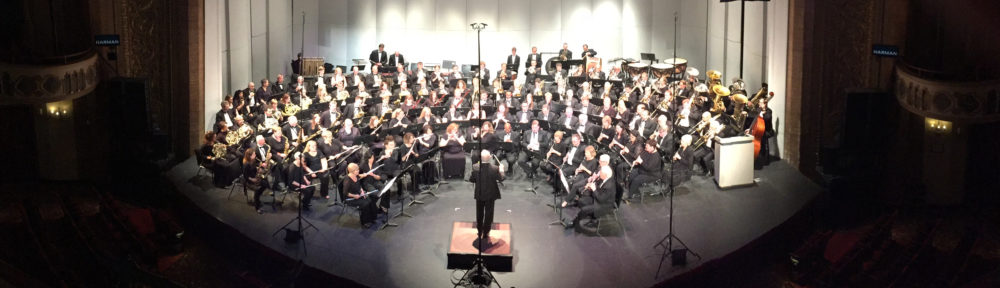
- Use the first 15 minutes of our June 22 rehearsal to look around and explore. Feel free to take photos with friends and your section in different areas of the hall. Eric set up a Google Drive dropbox folder set up to collect photos. Diller Hall is beautiful and we want you to get to know it right away. Go ahead and use the lobby stairs to go up to the 2nd and 3rd rings and check out the view from there. When you’re ready, access the stage from the side hallways or the short stairway directly from the orchestra seating area to the stage. And yes – go ahead and post photos to social media; we checked with Hackley and they approve whole-heartedly!
Finding Hackley
The Hackley School is located about a mile from TMH. Set your GPS for 293 Benedict Avenue, Tarrytown. The entrance is directly across Benedict from The Castle Hotel & Spa.

Take the first left into the parking lot.

 Once you’ve parked take the stairs up the hill. The Allen Center for the Performing Arts & Technology is right there at the top of the hill.
 If you have a large instrument or equipment, drive up the hill to the fork, and go left. You can pull up into the circle under the overhang, unload and then park.

Or drive past the Center to use the loading dock entrance:
 On concert days there is overflow parking in the lot up the hill, above the PAC.
Use the doors at the far right to come into the lobby.

The entrance to the hall is immediately on the left. Or take the stairs up to see the view from the 2nd and 3rd rings.

Please leave cases/coats backstage, not in the seats of the orchestra section of the hall. There is overflow space available in Black Box Theater on level 2, stage right.
If you’re curious, here are the website for the school and a very cool virtual tour:
Hackley website – https://www.hackleyschool.org/
Hackley virtual tour – https://hackleyschool.sprxvr.com/
See you all on Monday evening!
